- The Iceland you taste. The Iceland you experience. The Iceland you encounter between.
- The Iceland Most Travelers Drive Past
- Friðheimar: Where Iceland's Geothermal Energy Becomes Food
- Iceland's Food Story Begins With Its Landscape
- From the Farm to the Highlands
- Hveravellir: A Geothermal Landscape in the Wilderness
- The Road Connects the Experiences
- Hungurfit: Iceland at Its Most Remote
- Local Experiences Make the Journey More Meaningful
- Adventure by Day, Icelandic Hospitality by Night
- Why Go Beyond Iceland's Famous Sights?
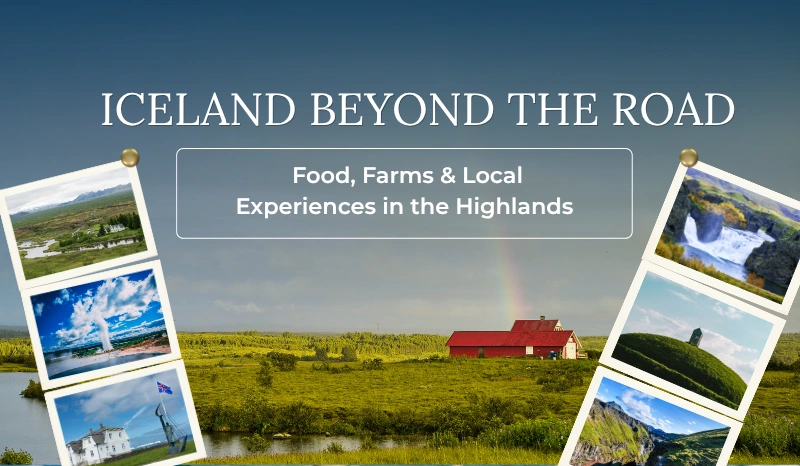
The Iceland you taste. The Iceland you experience. The Iceland you encounter between.
When people imagine Iceland, they often picture waterfalls crashing into black volcanic landscapes, glaciers stretching toward the horizon, and rugged roads disappearing into the Highlands.
But there is another Iceland worth discovering.
An Iceland Highlands road trip isn't simply about covering miles or collecting photographs. It is about understanding how people live, eat and adapt in a country shaped by volcanoes, glaciers, geothermal energy and a challenging climate.
That is what makes a guided driving expedition through Iceland's Highlands so different.
The landscape may be the reason you come. But the experiences along the way are what make you remember it.
The Iceland Most Travelers Drive Past
Iceland has become incredibly popular with travelers from around the world, particularly from the United States.
The country's famous waterfalls, glaciers, geothermal areas, and coastal landscapes make it easy to build an incredible itinerary without ever going far into the interior.
But the Highlands tell a different story.
Here, the landscape becomes increasingly remote. Roads turn into mountain routes. Services become limited. The horizon gets bigger.
And suddenly, Iceland stops feeling like a sightseeing destination and starts feeling like an expedition.
Yet even in these remote landscapes, there are reminders that Iceland is not simply wilderness.
People have learned to work with the land rather than against it.
One of the best examples is found at a geothermal greenhouse called Friðheimar.
Friðheimar: Where Iceland's Geothermal Energy Becomes Food
Imagine standing in the Icelandic countryside.
Outside, the air is cool, and the surrounding landscape is unmistakably northern.
Inside a greenhouse, however, it is warm, green, and full of growing tomatoes.
This is Friðheimar, a family-run greenhouse farm that uses Iceland's natural geothermal resources to create the conditions needed to grow crops.
It is one of the most interesting stops on the journey because it changes the way you think about Iceland. The country is famous for its volcanic activity.
Here, that same geological force becomes part of everyday life.
Geothermal energy isn't just something you see rising from a hot spring. It can help put food on the table.
During the expedition, Friðheimar becomes more than a sightseeing stop. It's a chance to have lunch in the greenhouse and experience Icelandic agriculture in a setting where nature and innovation work together.
Iceland's Food Story Begins With Its Landscape
To understand Icelandic food, you have to understand Iceland itself.
This is a country where the climate, geography, and isolation have historically influenced what people could grow, raise, and preserve. The sea provided an abundance of fish. The countryside supported sheep and other livestock. And geothermal energy created opportunities that would otherwise be difficult in such a northern climate.
Today, Icelandic cuisine combines these traditions with modern approaches to food.
That makes eating in Iceland more than simply another part of the itinerary.
It becomes a way of understanding the country.
The landscape doesn't just surround Icelandic food. It has helped shape it.
From the Farm to the Highlands
The contrast becomes particularly interesting as the journey moves deeper into Iceland.
One part of the trip introduces you to cultivated landscapes and geothermal agriculture. Another takes you across some of the most remote terrain in the country.
The Kjölur Route leads through the interior toward Hveravellir, where geothermal activity meets an immense Highland landscape.
Here, the relationship between Iceland and geothermal energy feels completely different.
At Friðheimar, geothermal heat helps grow food.
At Hveravellir, geothermal activity is part of the raw landscape itself.
Same geological force. Two completely different experiences.
That contrast is one of the things that makes traveling through Iceland's interior so fascinating.
Hveravellir: A Geothermal Landscape in the Wilderness
Hveravellir sits in the Icelandic Highlands between glaciers and is also known for its geothermal activity. The setting is extraordinary.
Open wilderness stretches around you, while geothermal features remind you that the earth beneath Iceland is still active.
It is difficult to separate Iceland's natural beauty from its geology.
Volcanic activity has helped create the island.
Glaciers have carved its valleys.
Geothermal heat continues to shape its environment.
And rivers carry water through landscapes formed by these forces.
You aren't simply looking at scenery.
You're looking at a landscape in motion.
5. Kerlingarfjöll: Where Fire and Ice Meet
Few places demonstrate Iceland's dramatic contrasts better than Kerlingarfjöll.
The journey takes you through black volcanic deserts, ancient lava fields, braided glacial rivers and valleys shaped by ice.
The colors and textures constantly change:
- Dark volcanic ground
- Green vegetation
- Mountain peaks
- Glacial water
- Steam and geothermal activity
This is the Iceland that photographs struggle to capture and experiencing it from behind the wheel makes the journey particularly immersive.
Instead of arriving at a viewpoint for ten minutes, the landscape unfolds gradually as you travel through it.
The Road Connects the Experiences
This is perhaps the biggest difference between a conventional Iceland holiday and a guided driving expedition.
The road isn't simply transportation, it connects the stories. You leave Reykjavík and gradually move away from the familiar, then travel through historic routes, only to encounter geothermal landscapes and mountain regions to explore.
You cross valleys and rivers, and eventually, find yourself in places where the landscape feels untouched.
The experience becomes less about:
“What attraction are we seeing next?”
and more about:
“What will the road reveal next?”
Hungurfit: Iceland at Its Most Remote
The Hungurfit Route is one of those places where this philosophy really comes alive.
The route takes you toward the Highlands, through rivers, valleys, and canyons.
Along the way, you'll encounter Markárfljótsgljúfur Canyon, where glacial waters have carved a dramatic ravine through the landscape.
Then the road narrows as you approach Hungurfit.
Green moss contrasts against black volcanic soil.
Mountains rise around the route.
And civilization feels increasingly distant.
This isn't a destination designed for mass tourism.
It is an experience built around remoteness.
And that sense of isolation is precisely what makes the Highlands so compelling.
Local Experiences Make the Journey More Meaningful
The most memorable travel experiences aren't always the biggest ones.
Sometimes they're quieter.
- A meal after a long day of driving
- Seeing how geothermal energy is used to grow food
- Learning how Iceland's environment influences its cuisine
- Stopping in a remote landscape and realizing there is no city, traffic or skyline around you
- These moments provide context to the dramatic scenery
They answer a question that photographs cannot: What does it actually feel like to experience Iceland?
Adventure by Day, Icelandic Hospitality by Night
The best news, is that an expedition through the Highlands doesn't mean sacrificing comfort, an important part of the Adventures Overland philosophy.
Your days can involve rugged terrain, remote roads and dramatic landscapes.
Your evenings offer the opportunity to slow down and relax in comfort.
And at the end of the expedition, you'll return to Reykjavík for a farewell dinner at a local restaurant serving Icelandic cuisine.
After days spent surrounded by mountains, rivers, and volcanic terrain, sitting down for a final meal creates a natural moment to reflect.
The journey is almost over.
But the stories are just beginning.
Why Go Beyond Iceland's Famous Sights?
You can visit Iceland and see extraordinary things without ever entering its Highlands.
But if you're looking for something deeper, the interior offers another perspective.
It's an Iceland of:
- Geothermal farms
- Volcanic landscapes
- Historic routes
- Remote valleys
- Local food
- Glacial rivers
- Enormous open spaces.
And perhaps most importantly, it gives you time to experience the country rather than simply pass through it.
For travelers coming from the US, that difference can be especially meaningful.
You aren't crossing an ocean to spend your vacation moving from one crowded attraction to another.
You're coming to a place where the journey itself can become the destination.
Written by
Julie Fishman
General Manager, USA
After 25+ years in the corporate world, Julie has learned first and foremost to care about the customer’s experience. She is now partnered with Adventures Overland to offer their guided driving expeditions to American guests for the first time. Her love of the road is grounded in her 4x4 club membership and a lifetime of global travel experience, combined with a love a nature and being of service.