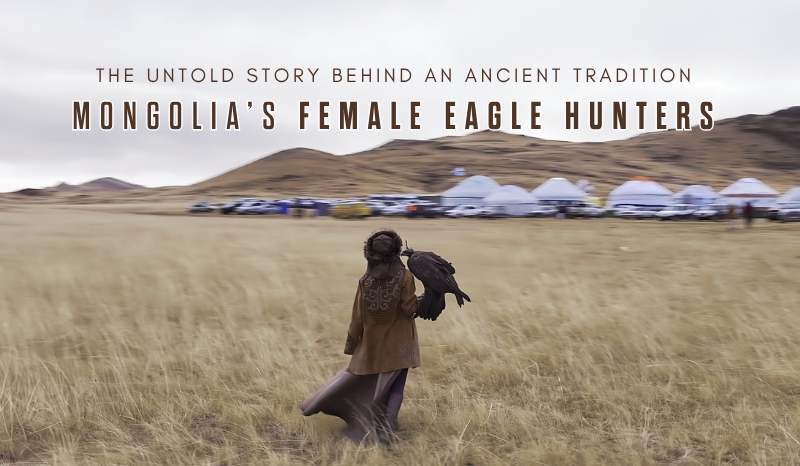
Imagine riding through the snow-covered mountains of western Mongolia and encountering a young woman holding a golden eagle on her arm. She wears traditional Kazakh clothing, a leather glove protects her arm from the eagle’s powerful talons, and the Altai Mountains stretch endlessly behind her.
You might assume she is part of a tradition passed down exclusively among men. But the history of Mongolia’s female eagle hunters tells a different story.
For centuries, women have been connected to hunting traditions across Central Asia. Their stories, however, have often received less attention than those of their male counterparts. Today, women such as Aisholpan Nurgaiv are helping the world discover a lesser-known side of Mongolia’s cultural heritage.
A Tradition Older Than Its Famous Stories
Eagle hunting is associated with the Kazakh community of Bayan-Ölgii, in western Mongolia. Known as berkutchi, traditional eagle hunters train golden eagles to hunt animals such as foxes, historically valued for their fur.
The exact origins of eagle hunting remain uncertain, but falconry has ancient roots across Central Asia. Historians have also identified evidence suggesting that women participated in hunting with birds of prey long before the modern era.
Historian Adrienne Mayor has discussed an ancient gold ring, dating to approximately 2,500 years ago, that appears to depict a woman on horseback hunting alongside an eagle. Although the image cannot prove that she was a Kazakh eagle huntress, it offers a fascinating glimpse into the possible history of women and hunting in ancient nomadic societies.
Princess Nirgidma: A Woman With an Eagle in 1932
One remarkable historical image features Princess Nirgidma of Mongolia photographed with a hunting eagle in 1932.
Her photograph provides a documented example of a Mongolian woman associated with eagle hunting decades before the world became familiar with Aisholpan Nurgaiv.
Little is documented about Princess Nirgidma’s hunting activities, but her image challenges the assumption that female eagle hunters are a recent phenomenon.
Their history did not begin with a viral photograph or a documentary. Instead, it forms part of a much wider story that is still being pieced together.
Aisholpan Nurgaiv: The Girl Who Captured the World’s Attention
In 2014, photographs of a young Kazakh girl holding a golden eagle attracted international attention. Her name was Aisholpan Nurgaiv, and she grew up in a family of eagle hunters in western Mongolia.
With her father’s support, Aisholpan learned to handle and train a golden eagle. At approximately 13 years old, she competed in Mongolia’s Golden Eagle Festival and won.
Her journey became the subject of the 2016 documentary The Eagle Huntress, introducing audiences worldwide to Kazakh culture, eagle hunting and the dramatic landscapes of the Altai Mountains.
But was Aisholpan the first female eagle hunter?
No. Her story brought unprecedented international attention to the tradition, but women had participated before her. Her achievement was becoming the first Mongolian woman to compete at the Golden Eagle Festival in Ölgii, not inventing a tradition that women had never practised.
Her story remains remarkable because it challenged familiar expectations about who could become an eagle hunter.
The Women Who Kept the Tradition Alive
Bagdat Muktepkekyzy, a Kazakh woman from Kazakhstan, learned eagle hunting from her grandfather and father in 1966, when she was ten years old. She later established an eagle-training school and helped organise initiatives to teach falconry and preserve the tradition.
Another notable huntress, Makpal Abdrazakova, attracted attention for her eagle-hunting abilities in the early 2010s, before Aisholpan became internationally famous. Their stories reveal that preserving cultural heritage involves more than practising a skill. It can also mean teaching others, organising competitions and ensuring younger generations have opportunities to learn.
More Than a Golden Eagle
For travellers, the sight of a female eagle hunter offers a glimpse into a culture that extends far beyond the bird itself.
The traditional clothing reflects regional identity and the demands of a cold mountain environment. The protective leather covering on the hunter’s arm helps shield against the eagle’s powerful talons. The bird’s hood, known as a tomaga, limits visual stimulation while it is being handled.
Behind these details lies a tradition shaped by generations of knowledge, horsemanship and experience.
A Story Still Being Written
The female eagle hunters of Mongolia remind us that history is often more complicated than the images we remember.
Princess Nirgidma’s photograph, Bagdat Muktepkekyzy’s decades of experience, and Aisholpan Nurgaiv’s international recognition each reveal a different part of this story.
Their experiences are not identical, but together they show that women have contributed to the history and preservation of eagle hunting in different ways.
And perhaps that is what makes their stories so compelling: they invite us to look again at a familiar tradition and discover the people whose stories have not always been told.
Some journeys introduce you to extraordinary landscapes. Others introduce you to the people who give those landscapes their meaning. In western Mongolia, the women behind the eagle-hunting tradition offer both.
Written by
Julie Fishman
General Manager, USA
After 25+ years in the corporate world, Julie has learned first and foremost to care about the customer’s experience. She is now partnered with Adventures Overland to offer their guided driving expeditions to American guests for the first time. Her love of the road is grounded in her 4x4 club membership and a lifetime of global travel experience, combined with a love a nature and being of service.